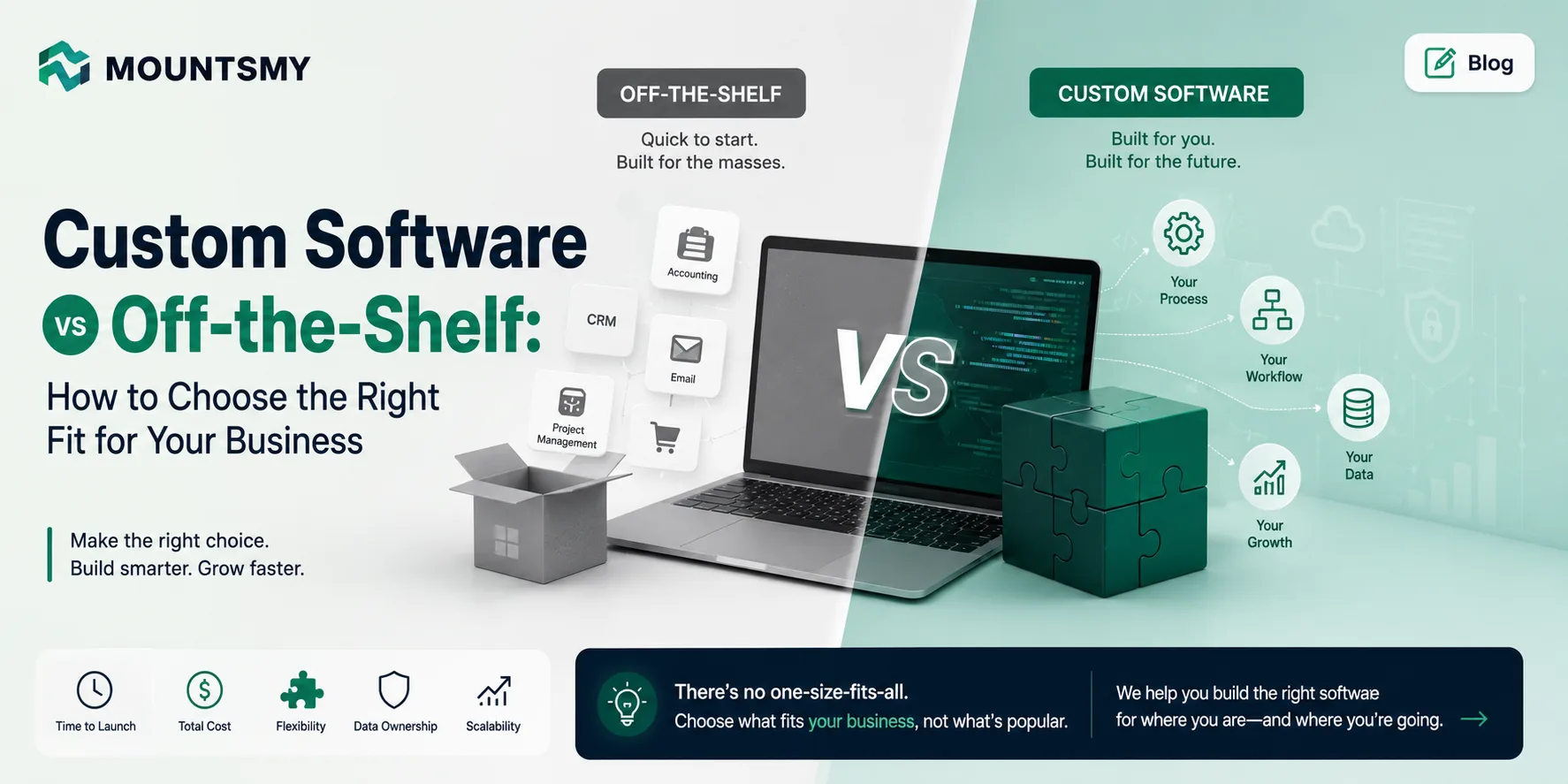
The real tradeoffs, side by side
| Off-the-shelf / SaaS | Custom software | |
|---|---|---|
| Time to launch | Days to weeks | Months, depending on scope |
| Upfront cost | Low — subscription pricing | Higher — one-time build cost |
| Ongoing cost | Scales with seats/usage, often unpredictably | Predictable — you own the maintenance cost |
| Fit to your process | You adapt your workflow to the tool | The tool adapts to your workflow |
| Data ownership | Vendor-controlled, export limits vary | Fully yours |
| Scaling ceiling | Bound by the vendor's roadmap and pricing tiers | Bound only by your own architecture |
When off-the-shelf wins
If the workflow you need is genuinely standard — accounting, CRM, basic project management, email marketing — someone has already built and refined it for years. Building your own version means re-solving problems a mature product has already solved, at a fraction of the cost you'd pay to build it yourself. Off-the-shelf is almost always the right call for anything that isn't part of your actual competitive differentiation.
When custom software wins
The calculus flips when:
- The workflow is your differentiation. If the way you do something is the reason customers choose you, forcing that process into a generic tool's constraints undercuts the thing that makes you different.
- You're stitching together five tools with duct tape. When "our process" actually means three SaaS subscriptions, a spreadsheet, and a Zapier automation holding it together, the integration fragility itself becomes the risk — a single custom system often ends up more reliable and cheaper over 2–3 years.
- Compliance or data residency requirements are strict. Industries like healthcare, fintech, and government contracting often have data-handling requirements that off-the-shelf vendors can't or won't accommodate.
- You're planning to scale past what the vendor supports. Per-seat SaaS pricing that looks reasonable at 20 users can become a serious cost center at 500 — and by then, migrating off it is far more disruptive than building custom would have been at the start.
Ask: is this workflow core to why customers choose us, or is it operational overhead everyone in our industry deals with the same way? Core differentiation leans custom. Shared operational overhead leans off-the-shelf. Most companies need both — a mix, not an absolute choice.
The hybrid path most companies actually take
Few companies are purely one or the other. The common pattern: run standard operations (accounting, HR, email) on SaaS, and build custom software specifically around the parts of the business that are unique — the core product, an internal tool that encodes a proprietary process, or a customer-facing platform. APIs make this easier than ever; a custom platform can integrate with your existing SaaS stack rather than replacing it wholesale.
What building custom actually costs you
Be honest about what "custom" means beyond the initial build: you now own ongoing maintenance, security patching, and the institutional knowledge to keep extending it. This isn't a reason to avoid custom software — it's a reason to build with a team that thinks about total cost of ownership from day one, not just the initial delivery date. A well-architected custom system, built with maintainability in mind, costs far less to run over three years than one built to hit a launch deadline and nothing else.
The bottom line
The question isn't "custom or off-the-shelf" as a company-wide policy — it's "custom or off-the-shelf" for each specific workflow. Standard problems deserve standard tools. The processes that actually make your business work the way it does deserve software built for exactly that.